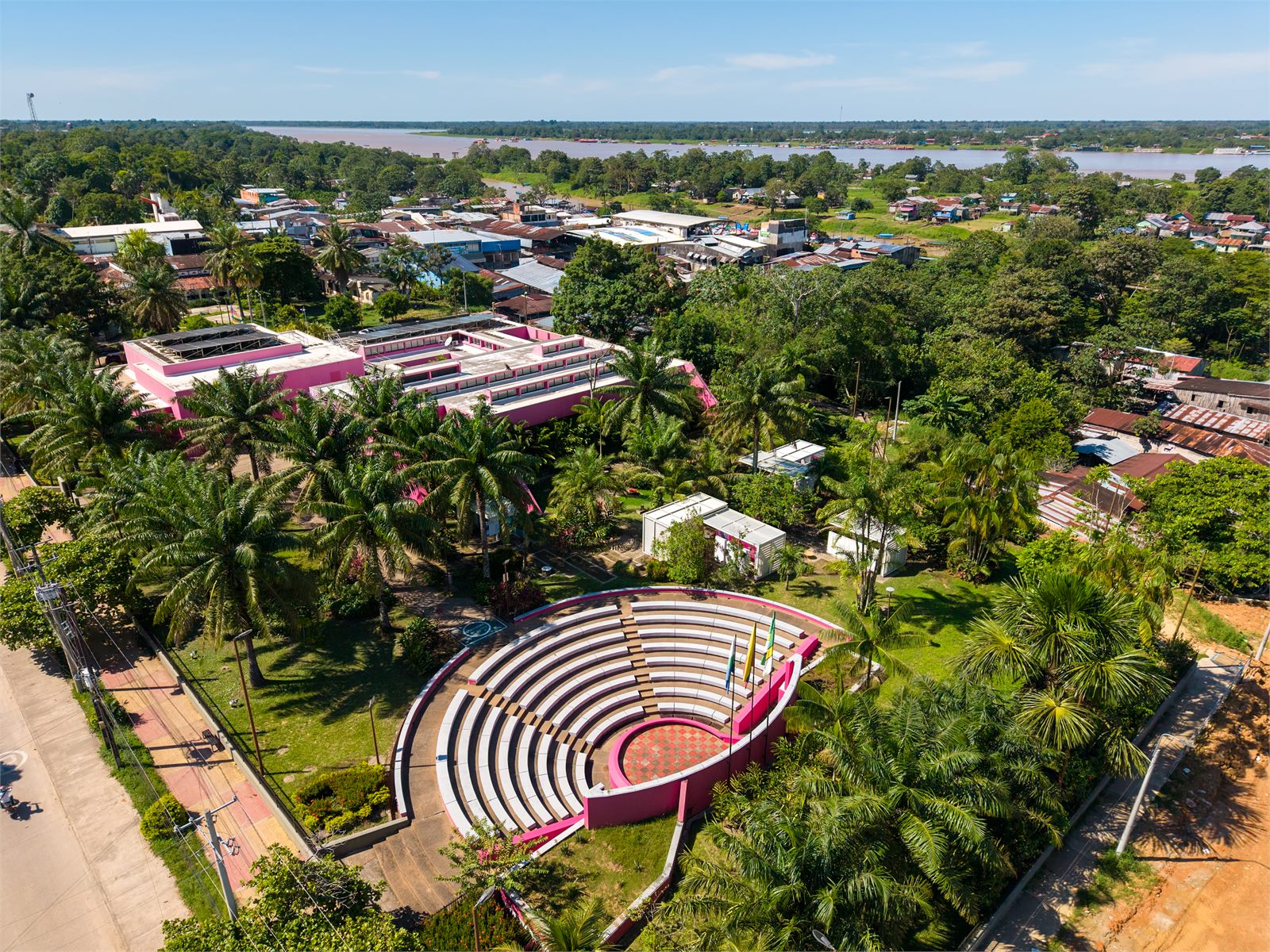
Ten minutes by boat from the civil port of Leticia there is a town that many travelers pass by without stopping to understand it. Santa Rosa Peru, on the Triple Frontier's Love Island, is the least visited of the three vertices of the Colombia-Brazil-Peru triangle. And it is, precisely for that reason, the most authentic.
It does not have the Portal da Fronteira or the commercial movement of Tabatinga. It does not have the tourist infrastructure of Leticia. What it has is a Peruvian Amazonian town on an island in the largest river in the world, with extraordinary gastronomy, its own history and the peculiarity that during the flood season it operates completely in stilt houses over the water.
Table of Contents
- Santa Rosa: What It Is and Why It Deserves a Visit of Its Own
- How to Get to Santa Rosa from Leticia
- Documents and Migration
- The Town: Streets, Houses and Palafitos
- Amazonian Peruvian Gastronomy in Santa Rosa
- The Brisas del Amazonas Restaurant
- The Island in the Crescent Season
- Crafts and Souvenirs from Peru
- Colombian Visa Extension in Santa Rosa
- How to Continue to Iquitos from Santa Rosa
- Practical Tips
- Frequently Asked Questions
Santa Rosa: What It Is and Why It Deserves a Visit of Its Own
Santa Rosa is a Peruvian population center belonging to the district of Ramón Castilla, province of Mariscal Ramón Castilla, region of Loreto (Peru). It is located on the left bank of the Amazon River, on an island — Santa Rosa Island, also called Island of Love — in front of the city of Leticia (Colombia) and a few minutes from Tabatinga (Brazil).
It is the official gateway to Peru along this border. Whoever wants to travel from Leticia to the Peruvian interior — to Iquitos, for example — needs to go through Santa Rosa for immigration procedures.
Its population: Approximately 2,000–3,000 people, mainly fishermen, farmers and merchants. A small and quiet community that lives to the rhythm of the Amazon River.
*What makes it special:*
- It is an authentic Peruvian Amazon town, without massive tourist infrastructure
- Its gastronomy is different and extraordinary — real Peruvian-Amazonian cuisine
- Increasingly, part of the town operates on the water in stilt houses — a unique image
- It is the third vertex of the Triple Border, less visited and more intimate
- From here begins the river route to Iquitos (3–4 days by river)
How to Get to Santa Rosa from Leticia
*By boat from the civil port of Leticia:*
- Duration: 5 to 10 minutes (no more)
- Boats are available during the day in the civil port
- The price of the crossing is very economical and negotiable at the port
- Important: Santa Rosa is on an island — there is no road, there is no taxi, there is no way to get there by land from Leticia
*From Tabatinga (Brazil):*
- Also by boat from the port of Tabatinga
- Similar time: 5–10 minutes
Schedules: Boats leave during the day according to demand. There are no fixed schedules like the boats in Puerto Nariño. You arrive at the port, wait for a boat with enough passengers or negotiate a private one.
Documents and Migration
*For the tourist tour of the day (without entering the interior of Peru):*
- Valid Colombian passport or citizenship card
- No visa is required for the day's tourist transit
- There is no mandatory immigration stamp for the day trip
*To formally enter Peru (to Iquitos or other cities):*
- Process your departure from Colombia at the Leticia immigration office or the airport
- Process entry to Peru at the Santa Rosa immigration office
- Check visa requirements according to your nationality
Colombian visa extension: Upon crossing into Santa Rosa and returning to Colombia, foreigners can obtain a new Colombian entry stamp — an additional 90 days of legal stay. See specific section below.
The Town: Streets, Houses and Palafitos
Santa Rosa is a small town without tourist pretensions. Its streets are narrow, the houses are made of wood and bright colors, children play on the main road and fishermen arrive with the day's produce in the early hours of the morning.
*What to see walking through the town:*
The welcome sign to Peru: The most requested photo of Santa Rosa. A sign at the entrance of the town with the colors of the Peruvian flag that all tourists photograph as evidence of having set foot in Peru.
The river boardwalk: The view from the Santa Rosa boardwalk towards the Amazon River, with Colombia and Brazil in front, is one of the most interesting angles of the Triple Border — different from the Tabatinga viewpoints because you are at the water level.
Daily life: The local market, the food stalls, the interaction between fishermen and merchants. Santa Rosa does not have designed tourist attractions — it has the real life of a Peruvian Amazon town.
The houses: The popular architecture of Santa Rosa mixes the Amazonian riverside style with Peruvian influences. Wooden houses on stilts are common even in summer — when the flood comes, those stilts keep them above the water.
Amazonian Peruvian Gastronomy in Santa Rosa
This is the most powerful argument for crossing to Santa Rosa — and the least known among travelers going to the Triple Frontier.
Peruvian cuisine has a depth and a culinary history that makes it one of the most recognized in the world. In Santa Rosa, that Peruvian cuisine merges with Amazonian ingredients from the river — and the result is extraordinary and completely different from what you find in Leticia or Tabatinga.
River ceviche: The most iconic dish. Instead of the marine fish in Lima ceviche, Santa Rosa uses fish from the Amazon River — pirarucú (paiche), dorado or gamitana. The base is the same: lemon, red onion, chili and cilantro. The result is different from coastal ceviche but equally brilliant — smoother, with the specific flavor of Amazonian fish.
Tacacho with cecina: A completely Peruvian-Amazonian dish with no equivalent in Colombian cuisine. Tacacho is toasted and mashed green plantain, mixed with lard until obtaining a compact and tasty mass. It is served with cecina — smoked, cured and dried pork. The combination of the fat from the tacacho and the smokiness of the jerky is addictive.
Juane: A festive dish from Peruvian-Amazonian cuisine. Rice cooked with spices (coriander, cumin, yellow chili), chicken or fish, hard-boiled egg and olives, all wrapped in bijao leaf and steamed or boiled. It is served unwrapped at the table — the presentation is part of the experience.
Inchicapi: Thick chicken soup with corn, peanuts and cilantro. A dish from indigenous Amazonian Peruvian cuisine that does not exist in Colombian cuisine.
Amazon chaufa rice: The Chinese-Peruvian fusion reached the entire Amazon basin with the Chinese immigrants of the 19th century. In Santa Rosa there is a version with local ingredients — Amazonian chicken, soy, vegetables. Different from Lima's chaufa but equally good.
Chicha Morada: The most representative Peruvian drink. Purple corn cooked with cinnamon, cloves, pineapple and lemon. Intense purple color, sweet and spicy flavor, refreshing. The perfect complement to any dish in the Amazon heat.
The Brisas del Amazonas Restaurant
The Brisas del Amazonas Restaurant is the gastronomic point of reference for travelers in Santa Rosa. Overlooking the river, it serves typical dishes of Peruvian-Amazonian cuisine with fresh ingredients from the Amazon.
It is the recommended place for lunch when the Triple Frontier is part of the tour itinerary. The river ceviche, the tacacho with cured meat and the juane are the most requested dishes.
Tip: Arrive early (before 12 pm or 1 to 2 pm) to ensure the best dishes available. In high season there may be a wait.
The Island in the Crescent Season
One of the most striking and least known images of Santa Rosa occurs during the flood season (December–May), when the Amazon River rises several meters.
With high water, the lower parts of the island are flooded. The businesses, houses and public spaces that in summer are on dry land are increasingly on the water — supported by the stilt houses that have always been their base but that in summer cannot be seen because the land is around them.
The town functions completely normally in this situation. The boats pass where there are streets in summer. The houses have their entrances at water level. Children go from one place to another in small canoes. It is an image of adaptation to the Amazon ecosystem that has been perfected for generations and that increasingly becomes visible in a spectacular way.
If your visit to the Amazon falls during the flood season, including a visit to Santa Rosa is especially recommended — the image of the town on the water is unique.
Crafts and Souvenirs from Peru
Santa Rosa has some craft stalls with Peruvian-Amazonian products that you don't find in Leticia or Tabatinga:
Shipibo crafts: The Shipibo-Conibo communities of Peru's Ucayali produce textiles, ceramics and decorative objects with unique geometric patterns — the kené — that represent their worldview. Some reach the Santa Rosa markets through trade networks.
Products from the Peruvian jungle: Natural remedies, essential oils, copaiba products, dragon's blood and other medicinal plants from the Peruvian indigenous tradition.
Peruvian foodstuffs: Yellow chili paste, mirasol chili, Peruvian spices, typical sweets. Products that you do not find easily in Colombia.
Local Tikuna-Cocama Crafts: The indigenous communities on the Peruvian side of the border also have crafts similar to those on the Colombian side — bags, necklaces, wooden figures — but with some stylistic differences of their own.
Colombian Visa Extension in Santa Rosa
This is especially relevant information for foreign travelers who are in Colombia with a tourist visa.
Upon entering Colombia, foreign tourists generally receive 90 days of stay. When those 90 days are about to expire, there is a way to get an additional 90 days without leaving for an international airport: cross to Santa Rosa (Peru) or Tabatinga (Brazil) and return to Colombia.
*The process in Santa Rosa:*
- Go to the civil port of Leticia and cross by boat to Santa Rosa (5–10 min)
- Present yourself at the Santa Rosa immigration office for the exit stamp from Peru (or just the entry stamp, depending on the process)
- Return to Leticia by boat
- At the port of Leticia or at the Leticia immigration office, obtain the new entry stamp to Colombia
- New 90 days of legal stay in Colombia
Cost: No immigration cost — only transportation (boat to Santa Rosa and back).
Important note: This procedure may change. Always check with the Leticia immigration office (Migración Colombia) the current conditions before making the crossing for this purpose.
How to Continue to Iquitos from Santa Rosa
For travelers with more time and an adventurous spirit, Santa Rosa is the starting point for the river route to Iquitos — the largest Peruvian city in the Amazon, inaccessible by road.
*Transport options:*
*Speed ​​boat (quick):*
- Duration: 10–14 hours of navigation
- Schedule: They leave at dawn or very early in the morning
- Stops in intermediate communities
- The fastest and most comfortable option
*Slow boat:*
- Duration: 3–4 days in a hammock or cabin
- Departs from Santa Rosa or from Benjamin Constant (Brazil)
- The most complete experience of the Peruvian Amazon
- Cheap but slow
*Necessary procedures:*
- Official departure from Colombia (Leticia migration office)
- Official entry to Peru (Santa Rosa immigration office)
- Check requirements according to your nationality
Practical Tips
Currency: In Santa Rosa the Peruvian sol (PEN) is used. In some tourist establishments they accept Colombian pesos and American dollars, but for the market, local restaurants and boats, the Peruvian currency gives a better rate.
Currency exchange: In Leticia there are exchange houses where you can exchange pesos for soles before crossing. Also in Tabatinga you can get soles.
Schedule: Santa Rosa operates on Lima time (one hour less than Colombia on regular time). Keep this in mind if you combine the tour with Tabatinga on the same day (Tabatinga has a different time).
Language: Peruvian Spanish. There is no language barrier for Colombians.
Water and food: Bring bottled water from Leticia. The restaurants serve fresh food but the tap water is not drinkable.
Frequently Asked Questions
Is a visa required to enter Santa Rosa Peru from Leticia? For the tourist tour of the day, no. With a valid passport or ID and without formally entering Peru (without immigration stamp), you can visit Santa Rosa as part of the Triple Border tour.
How long does it take to get to Santa Rosa from Leticia? Between 5 and 10 minutes by boat from the civil port of Leticia. There is no road — Santa Rosa is on an island.
What is most worth eating in Santa Rosa? River ceviche (with fresh Amazonian fish), tacacho with cured meat and juane are the most representative dishes. The Brisas del Amazonas Restaurant is the reference point.
Can the Colombian visa be extended by crossing to Santa Rosa? Yes. Foreigners with a Colombian tourist visa can get an additional 90 days crossing to Santa Rosa and returning to Colombia. Verify the updated procedure with Migración Colombia in Leticia.
How do you get to Iquitos from Santa Rosa? By speed boat (10–14 hours) or slow boat (3–4 days). From Santa Rosa there are regular departures to Iquitos, always prior to the immigration procedure to enter Peru.
Santa Rosa is part of our Triple Frontier tours. [leticia.travel](https://leticia.travel)
Plan your Amazon trip
We help you choose the best combination of days, activities and season based on what you want to experience in Leticia, Puerto Nariño and the triple frontier.