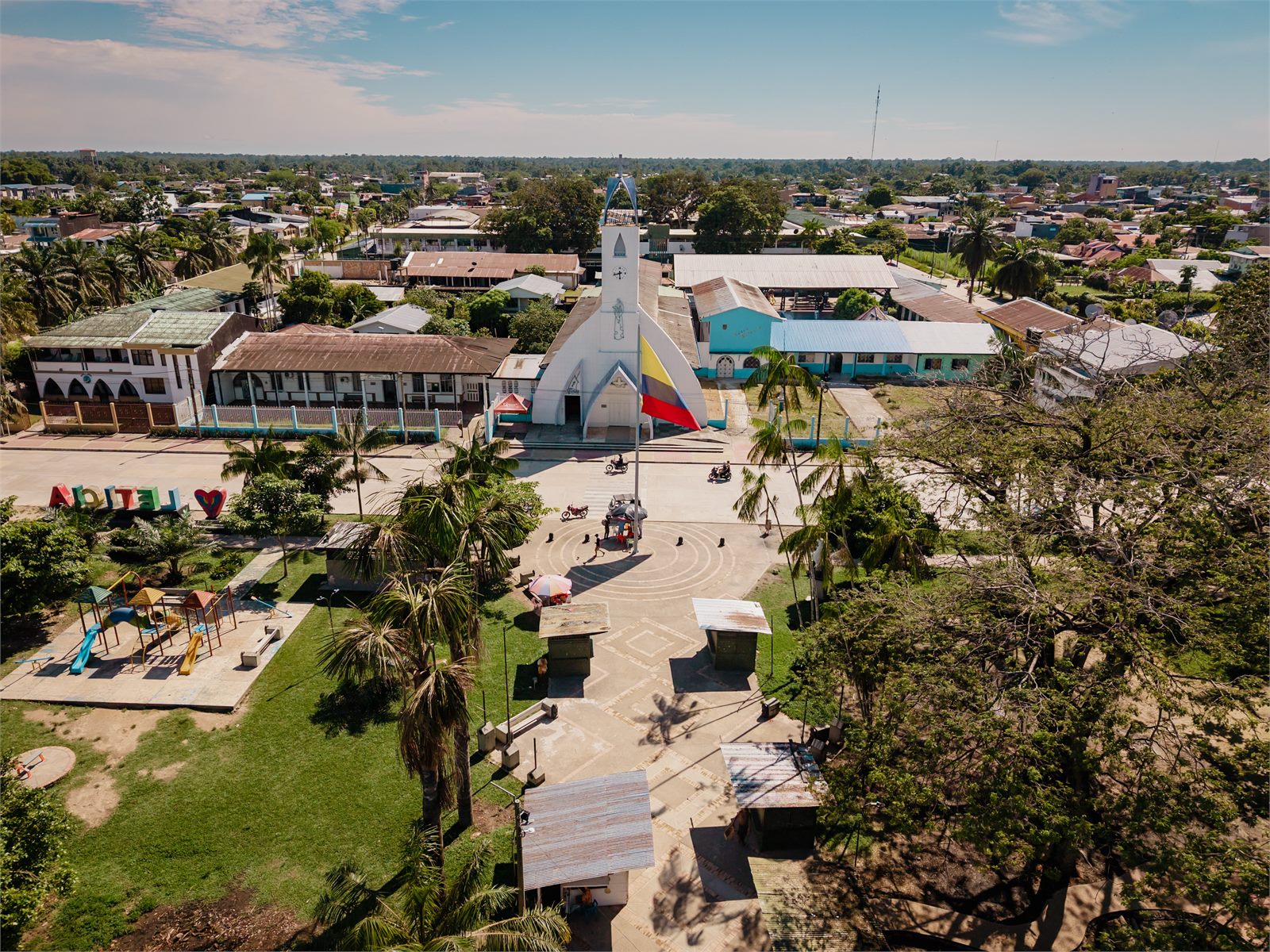
There is something curious in the relationship between Leticia and Tabatinga: they are two cities in two different countries that share the same urban area, the same airport, the same streets in some places and the same river. Crossing from Colombia to Brazil from Leticia is nothing like crossing other Latin American borders. It's like going from one neighborhood to another — ten minutes on foot, no walls, no forms, no lines.
And on the other side you find another cuisine, another language, another riverine culture — all within the Amazon itself.
This is the complete guide to Tabatinga Brazil for those traveling from Leticia.
Table of Contents
- Tabatinga: The Brazilian City of the Amazon
- How to Get from Leticia to Tabatinga
- Documents and Immigration Procedures
- The Portal da Fronteira: The Obligatory Photo
- Tabatinga viewpoints
- The Church and the Center of Tabatinga
- The Municipal Market and the Tikuna Fair
- Gastronomy in Tabatinga
- El Festisol: The Most Important Festival of Tabatinga
- Shopping in Tabatinga
- How to Get to Tabatinga from Brazil
- Practical Tips
- Frequently Asked Questions
Tabatinga: The Brazilian City of the Amazon
Tabatinga is a Brazilian city in the state of Amazonas (Brazil), with a population of approximately 65,000 inhabitants. It is located in the extreme west of the state, directly on the border with Colombia and in front of Love Island (Santa Rosa, Peru) in the Amazon River.
Its history is linked to the Brazilian military presence in the border area — the 8th Batalhão de Infantaria de Selva (8th BIS) is one of the most important installations in the city — and to the border trade with Colombia and Peru that has defined its economy for decades.
What makes Tabatinga especially interesting for the traveler is not only its status as a border city but the cultural mix that this generates. Here Colombian Spanish, Brazilian Portuguese and the indigenous Tikuna and Kokama languages ​​coexist in the same urban space. Currencies mix, cuisines merge and identity is an Amazonian hybrid that does not exist anywhere else.
How to Get from Leticia to Tabatinga
On foot: The option most used by tourists. The center of Leticia and the border area with Tabatinga are a 10–15 minute walk away. Simply walk south from the center of Leticia following the main street until you reach the Portal da Fronteira.
By motorcycle taxi or tuk-tuk: Motorcycle taxis are the typical transportation in Tabatinga. From the center of Leticia to the Portal da Fronteira: 5 minutes and very economical. You will find them on any corner on the Colombian side.
By taxi: From Leticia airport to the center of Tabatinga: 10–15 minutes. Negotiate price before raising.
There is no immigration control for tourists in daily transit between Leticia and Tabatinga. You just cross.
Documents and Immigration Procedures
*For the tourist tour of the day (Leticia → Tabatinga → return to Leticia):*
- Valid Colombian passport or citizenship card
- No visa required
- There is no immigration stamp
*To travel to the interior of Brazil (Manaus, Belém, etc.):*
- Process formal migration at the Tabatinga airport office (or Leticia airport on the Colombian side)
- Check visa requirements according to your nationality
For foreigners who want to extend their Colombian visa: Cross to Tabatinga, process exit from Colombia at the immigration office and entry to Brazil, then return to Leticia for a new 90-day Colombian stamp. No additional cost beyond transportation.
The Portal da Fronteira: The Obligatory Photo
The Portal da Fronteira is the most photographed monument of the Triple Frontier and the most recognizable symbol of Tabatinga. It is an arch that marks the official line between Colombia and Brazil, with the flags of the two countries.
It's located exactly on the border line — you can stand with one foot in Colombia and the other in Brazil for the classic travel photo. At night it is illuminated and is especially photogenic.
A few meters from the Portal are the letters BRASIL in the green and yellow colors of the Brazilian flag — another iconic photo that has become a symbol of the city.
*Tips for photographing the Portal:*
- The best photos are taken in the early morning or at dusk — midday light is very harsh
- Wear clothes in the colors you prefer — the Portal background has a lot of detail
- There are local vendors around offering Brazilian hats and accessories for photos
Tabatinga viewpoints
La Comará Viewpoint: The most famous in Tabatinga. Panoramic view of the Amazon River with Colombia and Peru in the background. In the afternoons it has a rumba atmosphere with live music and local shows. The best point to see the sunset over the Amazon from Brazilian soil. There are restaurants and bars in the area.
Mirador Voyager: More informal and youthful atmosphere than La Comará. Direct views of the river, music, popular with young residents of the area. Good option for the afternoons.
Mirador La Fera: Quieter, oriented towards river views and photography. Less crowded than the previous ones.
The Church and the Center of Tabatinga
Nossa Senhora do Perpétuo Socorro Church: The most imposing construction in Tabatinga. Completed in 1989, its four towers are inspired by the historic São Francisco Xavier Fort. It is located on Rua Pedro Teixeira, a few blocks from the center. It's worth going inside — the interior is simple but the building from the outside is one of the most photographed in the city.
The center of Tabatinga: More commercial and less touristy than Leticia. Clothing stores, Brazilian supermarkets, small restaurants. The atmosphere is different from Leticia — more Brazilian, more informal, with Portugues as the dominant language in the mixed establishments.
The Municipal Market and the Tikuna Fair
Tabatinga Municipal Market: The daily economic heart of the city. Fresh Amazonian fish from the Amazon — pirarucú, tambaqui, surubà — tropical fruits, condiments and local products that you don't find in Leticia. To see the market is to understand how the people of Tabatinga live.
Recommended time: In the mornings, before 10 am. The freshest fish and greatest variety are available early.
Tikuna Fair: Craft space of the Tikuna communities of the region. Woven bags, seed necklaces, wooden figures, fabrics with indigenous patterns. Quality varies — take time to review carefully before purchasing.
Gastronomy in Tabatinga
The gastronomy of Tabatinga is one of the great arguments for crossing from Leticia. Brazilian-Amazonian cuisine has its own identity:
Charcoal tambaqui: The dish that defines the gastronomy of Tabatinga. The tambaqui (the same Colombian gamitana) prepared over embers with coarse salt and lemon. Crispy skin, fatty and juicy meat inside. Served with white rice, Brazilian black beans, fariña and plantain. If you are going to eat only one thing in Tabatinga, let it be this.
Espetinhos: Skewers of beef, chicken or a mix, seasoned with Brazilian spices and grilled over charcoal. The street stalls serve them hot all day long at very affordable prices.
Rodizios: Brazilian-style mixed meat restaurants — waiters pass around with different cuts on skewers until the diner covers the cue card. In Tabatinga they have an Amazonian version with local meats.
Pirarucú / Fried Paiche: The largest fish in the Amazon, prepared in fried fillets in the Brazilian way. White meat, firm and soft, with fariña and rice.
Tacacá: Amazonian soup with river shrimp, jambu (a plant that numbs the lips slightly), tucupi (fermented cassava broth) and tapioca. A unique gastronomic experience from the Brazilian Amazon — unlike anything you may have tried.
Amazonian chocolates: In some stores and in the market you find artisanal bars made with local cocoa, copoazú, camu camu and guarana. They are a gastronomic souvenir that almost no one knows about and that everyone who tries it includes on their shopping list.
Chef Panduro Restaurant: The chef who popularized the stuffed gamitana (fish suckling pig) nationwide has his reference restaurant in Tabatinga. A historical reference of the Amazonian gastronomy of the Triple Frontier.
Natural açaÃ: In Tabatinga, fresh açaà is an institution. It is served in bowls with fariña, granola or alone. Completely different from the industrialized açaà that reaches Colombian cities.
El Festisol: The Most Important Festival of Tabatinga
The Festisol — Festival Internacional de Tribos do Alto Solimões is the most important cultural event in Tabatinga and one of the most extraordinary in the entire Amazon region.
What it is: A folklore competition between two associations representing indigenous nations:
- Onça Preta (Ticuna nation)
- Onça Pintada (Omagua nation)
What happens: Tribal songs, elaborate choreography, traditional ceremonial costumes, giant allegories, live Amazonian music. It lasts several consecutive days with nightly presentations.
Where: Tabatinga Cultural Center — the Onçódromo, a space designed specifically for this event.
Free admission.
*Recent editions:*
- 2024 (X Festisol): November 28 to December 1. Guest artists: Solange Almeida and Mari Fernandez.
- 2025 (XI Festisol): September 25 to 28. Champion: Onça Preta.
Updated information: @festisoltbt and @festisoltabatinga on Instagram.
If your trip to the Amazon coincides with Festisol dates — especially in September or December — plan specifically to attend. It is one of the most authentic and least known cultural celebrations in the Amazon.
Shopping in Tabatinga
Footwear Route (Avenida Marechal Mallet): Tabatinga's main avenue has dozens of footwear, clothing and accessories stores at prices significantly lower than in Colombia. Many Leticia residents cross regularly to shop here.
Brazilian supermarkets: Brazilian products — chocolates, coffee, hygiene products, snacks — at affordable prices. Tourists often bring Brazilian coffee, Amazonian chocolates and guarana as souvenirs.
Currency: The Brazilian real (BRL) is the official currency. In tourist establishments and many stores in the center they accept Colombian pesos and American dollars, but the local currency always gives a better rate in the market and local stalls.
How to Get to Tabatinga from Brazil
For travelers arriving from other Brazilian cities:
*By plane from Manaus:*
- Airline: Azul Linhas Aereas
- Direct flight to Tabatinga (TBT): ~2 hours
- Tabatinga airport is in the border area shared with Leticia airport
*By river from Manaus:*
- Fast boat: 36–48 hours sailing the Amazon River
- Slow boat (recreio): 4–6 days in a hammock or cabin
- Port of arrival: Port of Tabatinga
Practical Tips
Bring pesos and reales: Colombian pesos are accepted in many tourist establishments in Tabatinga, but for the market, street stalls and local restaurants, reales give a better rate.
Portuñol works: If you don't speak Portuguese, portuñol (Spanish mixed with Portuguese) works perfectly in Tabatinga. The proximity to Colombia means that merchants are accustomed to Spanish.
Schedules: Tabatinga operates on Brasilia time — one hour more than Colombia. Keep it in mind for the return.
Safety: Tabatinga is a safe city for tourism. Normal precautions for any city apply.
Tabatinga airport: It is in the border area, literally next to the Leticia airport. If you have a connecting flight from Manaus, the journey to the center of Leticia or Tabatinga is 10–15 minutes.
Frequently Asked Questions
Do I need a visa to enter Tabatinga from Leticia? For the tourist tour of the day, no. Colombians and most Latin Americans only need a valid passport or ID. There is no immigration control for the tourist traffic of the day.
How long does it take to get to Tabatinga from Leticia? 10–15 minutes walking or 5 minutes by motorcycle taxi from the center of Leticia.
When is Festisol in Tabatinga? Generally in September or between November and December. In 2025 it was from September 25 to 28. For updated dates: @festisoltbt on Instagram.
What currency is paid in Tabatinga? In Brazilian reals (BRL). In tourist establishments they accept Colombian pesos and dollars, but the local currency gives a better rate especially in the market and street stalls.
What is the best to eat in Tabatinga? Charcoal tambaqui is the most representative dish — the gamitana prepared over embers with the Brazilian technique. Also tacacá (Brazilian Amazonian soup) and artisanal Amazonian chocolates.
Visit Tabatinga as part of our Triple Frontier tours. [leticia.travel](https://leticia.travel)
Plan your Amazon trip
We help you choose the best combination of days, activities and season based on what you want to experience in Leticia, Puerto Nariño and the triple frontier.