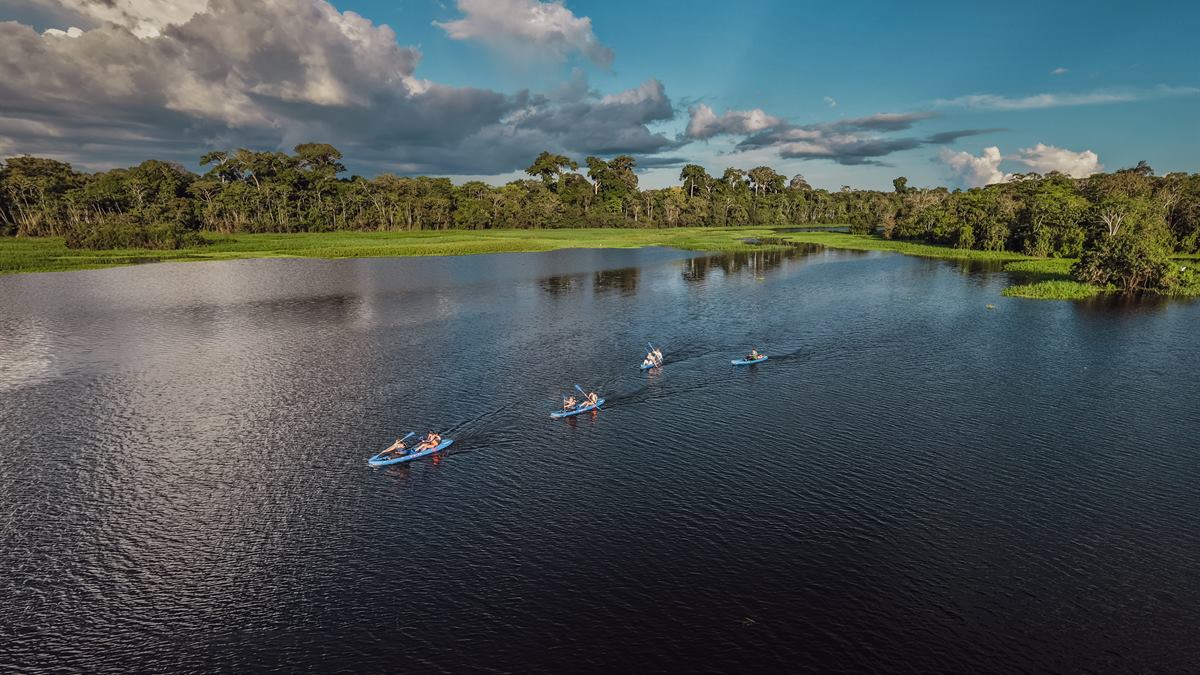
There is an Amazon that most travelers do not know about. Not because it is difficult to access — but because to find it you have to go at the right time. The Amazonian winter, the growing season, transforms the landscape in a way that has no equivalent anywhere else in Colombia or the region.
When the river rises, the lowland jungle disappears under the water. Paths become canals. The trees emerge from the river with their trunks submerged. And then appears the várzea — the most extraordinary flooded forest on the planet — where kayaking among the trees with dolphins swimming meters from the oars is an experience for which no description is sufficient.
What is the Amazon Winter?
The Amazon winter — also called the rising or flood season — is the period in which rains in the Peruvian Andes feed the Amazon water system and raise the level of the Amazon River.
The process begins in December, accelerates between February and March, and the river reaches its highest point in April — up to 8 meters above its September minimum level. Since May the river begins to descend.
Those 8 meters transform the jungle: the low land is flooded, the paths disappear under water and the várzeas appear - navigable flooded forests where the trees emerge from the river and the jungle becomes an aquatic labyrinth. Unique in the world. Only possible in Amazonian winter.
The Weather in Winter: Without Surprises
The most common misunderstanding about the Amazonian winter: that it rains much more than in summer. It is not like that.
The local rainfall pattern in Leticia is the same in any season — about an hour of downpour a day that falls, stops, and clears. Local rainfall is not related to river rise — river rise is determined by rainfall in the Peruvian Andes.
Temperature: 25°C–30°C. Something more manageable than the peak heat of August-September in summer.
Mosquitoes: More present near flooded várzea areas. Repellent with DEET is critical in any season but on tours through the flooded jungle, apply it more frequently.
Kayaking in the Flooded Jungle: Why it is Unique
Between February and May, the Yahuarcaca Lagoon System and the Tarapoto Lakes expand into the surrounding forests, forming aquatic labyrinths where you can literally paddle a kayak through the interior of the Amazon jungle.
Trees emerge from the water with their trunks submerged. The branches form a green roof over the kayak. Sloths hang at eye level. Monkeys jump in the canopy. Pink dolphins swim meters from the paddles.
There is no engine. There is no noise. Only the oars moving the water and the living jungle surrounding you in all directions.
This experience does not exist anywhere else in Colombia. It is not available in the Amazon summer. It is exclusive to winter, the moment when the river rises and the jungle transforms.
Lakes of Tarapoto in Creciente
Lake Tarapoto is the best dolphin watching point in the region in any season. But in winter it becomes something different.
With high water, the lagoon system expands towards the forests on its banks. Navigable canals appear between the trees that in summer are paths. The pink and gray dolphins follow the fish that also take advantage of the high water to enter the flooded jungle.
Kayaking on the Tarapoto Lakes in winter allows you to explore corridors between trees with dolphins swimming around — a proximity and context that is not possible in summer, with the lake at its normal level.
Dolphins in the Interior Lakes
Dolphin watching in winter is different from summer. Not better or worse — different.
In summer the botos are concentrated in the main, more predictable channels. In winter they disperse through the flooded jungle following the fish. The sighting in a kayak — without a motor, in silence, with the dolphin emerging between the branches two meters from the oars — is an image that those who have experienced it describe as unrepeatable.
More Activities and Better Accesses in Winter
The Amazon winter does not reduce the menu of experiences — it expands it. With high water, the boats arrive directly at piers that in summer are at a distance and require a walk. Some indigenous communities that are reached by trail in summer are visited by sailing to the shore in winter.
Winter has more water activities available and easier access to certain parts of the jungle.
What You Can't Do in Winter
River beaches: The banks are under water. The sandy beaches that emerge between July and November are covered during the winter.
Swimming on the banks of the river: The riverbank areas where swimming in summer are flooded.
Piranha fishing in its best version: It is possible to do it but the summer concentrates the fish more and the fishing is more productive.
We Can Do Hikes All Year
This point differentiates our operation from most agencies in the area.
Operators who work exclusively in Peruvian várzea areas lose access to winter hikes because their trails remain under water. In winter, those operators offer only boat and kayak.
We work in two areas:
Mainland: High jungle that never floods. Walks available 365 days, at any level of the river. In the middle of winter with the Amazon at its highest peak, our travelers walk through dry jungle.
Várzea: The flood-prone areas where in winter we do kayaking, dolphin watching in lakes and tours through canals between trees.
On a winter day we can do: hike on dry land + kayak in flooded jungle. What most operators cannot offer.
Month by Month: What to Expect
December–January: The river rises from summer levels. Transition — first channels forming. 4–5 days.
February: Kayaking in Yahuarcaca and Lagos de Tarapoto begins to be available. 5 days.
March: Crescent in full ascendancy. Kayak, dolphins in lakes, tours between trees. 5 days.
April: Highest point. The várzea at its best. Tarapoto Lakes at their highest level. 5–6 days.
May: The river begins to go down but kayaking is still available. 5 days.
Luggage for the Amazon Winter
Same fundamental rule: 25–30 liter backpack.
Differences compared to summer:
Double repellent: In várzea areas mosquitoes are more abundant. Minimum 3 bottles of DEET for 4 days.
Quality dry bags: In kayaking, exposure to water is greater. Let them be truly airtight.
River type sandal: For kayaking and boarding in areas with shallow water.
The same as in summer:
- Rubber boots (always, in any season)
- Quick-drying light clothing
- Sunscreen SPF 50+
- Wide-brimmed hat
- Rain poncho
- Flashlight and powerbank
- Cash in Colombian pesos
For whom is the Amazon Winter?
The Amazon winter is for everyone — you don't need to have gone before in summer or have previous kayaking experience. The tours are designed for travelers of any level.
What winter adds is a different dimension: the Amazon is bigger, more aquatic, quieter on kayak tours. The forest that floats, the dolphins among the branches, the trees that stick out of the water.
If your dates fall between December and May, don't change them thinking that winter is worse. It's just different — and for many travelers, more memorable.
Frequently Asked Questions
When is the Amazon winter in Colombia? From December to May. The river begins to rise in December, reaches its highest point in April and begins to descend in May.
Does it rain more in the Amazon winter than in summer? No. The local rainfall pattern is the same all year round: approximately one hour a day. What varies between seasons is the level of the river.
When is the best time in winter to visit the Amazon? February to May. Kayaking in Yahuarcaca and the Tarapoto Lakes is available since February; In April the várzea is at its best.
Can you kayak in winter without prior experience? Yes. The tours are designed for any level. The guides accompany and the rhythm adapts to the group.
How many days are needed in the Amazon winter? 5 days at the peak (February–May). In the transition months (December–January and May), 4 days is enough.
*Tours for the Amazon winter: leticia.travel*
Do you want to experience the Amazon with a clear route?
Write to us on WhatsApp and we will help you choose between a 2, 3 or 4-day tour depending on your flight, season and travel style.