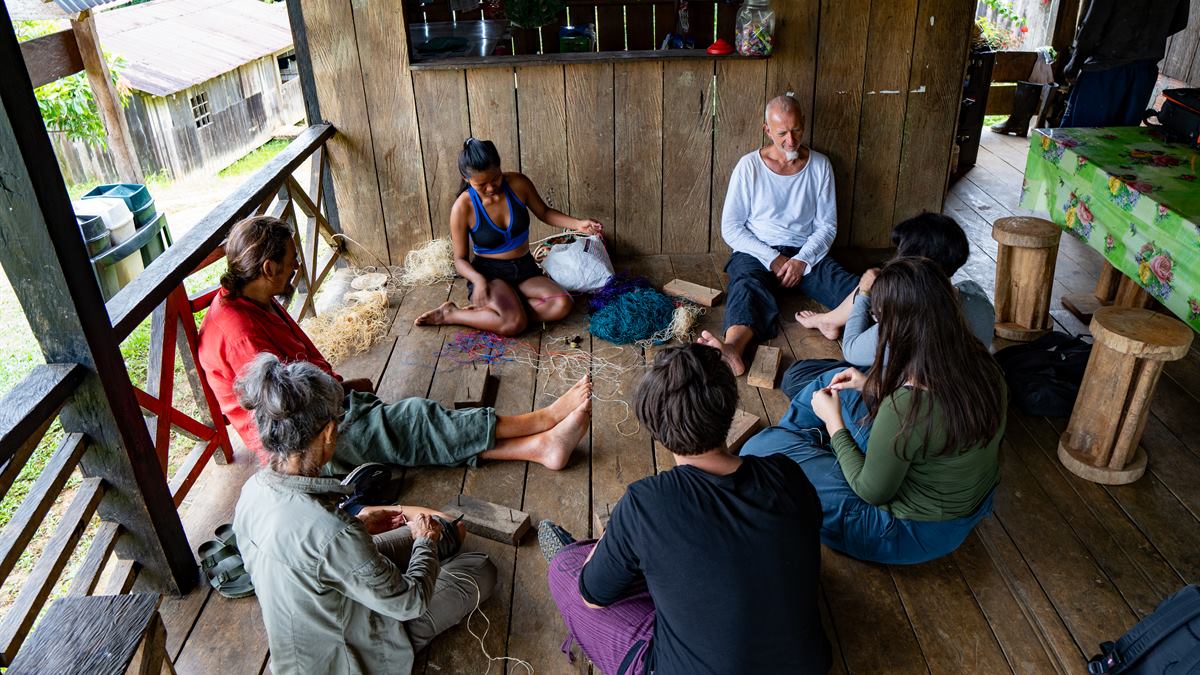
Travel guides say that visiting indigenous communities is "an enriching experience." It is true, but that phrase does not convey anything of what really happens when an elder Huitoto shares the wisdom of tobacco and coca with you, or when the children of the community invite you to swim with them in the tributaries of the Amazon River and you discover that in the water they are infinitely more agile than you.
The visit to indigenous communities of the Amazon is more than a tourist attraction. It is an encounter with a way of understanding the world that has been around for millennia and that modernity has not managed to erase.
The Indigenous Peoples of the Triple Border
In the region where Colombia, Brazil and Peru meet on the Amazon River, there live several indigenous peoples whose traditions precede by thousands of years the national borders that the states drew over their ancestral territories.
They are not living museums. They are real communities — with their internal conflicts, their adaptations to the modern world and their resistance to it, their deep knowledge of the jungle and their traditions that continue to be transmitted from generation to generation. Entering a community with that perspective makes the experience completely different.
Tikuna: The Largest Town
The Tikuna are the largest indigenous people in the Colombian Amazon — approximately 7,000 in the Colombian Amazonas department, with more than 50,000 in total between Colombia, Brazil and Peru.
The Tikuna language is a language isolate: it has no known relationship with any other language family in the world. It is one of the most unique linguistic heritages on the continent.
Their social organization is based on family clans of totem animals divided into two large groups: clans of terrestrial animals and clans of aerial animals — such as the macaw clan or the paucara clan. Marriage between people of the same clan is prohibited, which structures the entire social life of the community.
The Pelazón is its most important ceremony — the rite of passage for young girls upon reaching puberty. For several days the community celebrates with masato, music, dance and the public presentation of the young woman before all the clans. It is one of the most vivid and best preserved indigenous rituals in the Amazon.
Their crafts — llanchama bark masks, fabrics painted with natural pigments, Amazonian seed necklaces — are recognized throughout the region for their elaboration and symbolism.
Huitoto: The Children of Tobacco, Coca and Sweet Yuca
The Huitoto (Murui-Muinane) identify themselves with a principle that explains everything: they are the children of tobacco, coca and sweet cassava. It is not a metaphor — it is their cosmogony, their letter of introduction, the explanation of who they are and where they come from.
Mambe (processed coca) and ambil (paste tobacco) are the two axes of Huitoto intellectual life. They are not recreational substances — they are tools for thinking, deep conversation, and transmission of knowledge. The mambeadero — the nighttime meeting place where the elderly sit to mambear — is the central institution of Huitoto life: there conflicts are resolved, myths of origin are told, ancestral knowledge is transmitted.
The sweet cassava completes the sacred trio — the basic food, the symbol of the earth's generosity.
Yagua: The Masters of the Blowgun
The Yagua are unmistakable for two things: their extraordinary mastery of the blowpipe and their ceremonial costumes made of reddish natural fibers.
The Yagua blowgun can measure up to 3 meters in length. Hunters shoot down birds and monkeys in the treetops with darts impregnated with curare — a plant poison that paralyzes without contaminating the flesh. The aim they demonstrate in the tourist demonstrations leaves all visitors with their mouths open.
On visits to Yagua communities, travelers can try to shoot the blowgun. The comparison of aim between the guide and the tourist is always a moment of great laughter.
Their language, from the Peba-Yaguan family, continues to be spoken in some communities on the Peruvian and Colombian sides, although it is at risk of extinction.
Cocama: Navigators of the Atacuarà River
The Cocama (Kukama) are navigators by heritage — for centuries they were among the most skilled on the Amazon rivers, with canoes that traveled hundreds of kilometers.
In the Leticia region they mainly inhabit the area of ​​the Atacuarà River, with communities such as 7 de Agosto, San Juan de Atacuarà and Ronda. Their culture has absorbed much mestizo influence, but the knowledge of the river — fish, currents, cycles of the Amazon — continues to be transmitted from generation to generation.
La Maloca: More than a House
The maloca is the most characteristic communal construction of the Amazonian towns. Large, oval or rectangular in shape, built with wood, palm and plant fibers. Social life, ceremonies, and the transmission of knowledge converge there.
What makes it special is not only its function but its cosmological meaning: the roof represents the sky, the floor the earth, the columns are the trees of the world. Entering a maloca understanding that language completely transforms the experience of being inside.
What you are going to experience during the visit
A well-organized visit does not have a rigid script — what happens depends on the community, its members, and the moment. But in general terms:
Arrival by boat: Most communities are accessed by river.
Welcome: Quiet, without a rehearsed show. A meeting between people.
Jungle tour: The guides from the community itself show medicinal plants, useful trees, animals. The botanical knowledge they have is extraordinary.
Cultural demonstrations: Blowgun (especially with the Yagua), making fariña, music with traditional instruments, explanation of their own cosmology.
Food: On full-day or overnight tours, lunch is made in the community with food prepared by the families that same day.
Crafts: Space to see and buy directly from the artisan.
Indigenous Gastronomy: Fariña, Patarasca and Masato
Fariña: Toasted cassava flour. The manufacturing process — peeling, grating, juicing, roasting to remove the toxic compounds from yuca brava — is fascinating to watch. Universal companion with fish.
Patarasca: River fish marinated in jungle spices, wrapped in bijao leaf and roasted directly over charcoal. The purest preparation of indigenous Amazonian cuisine.
Casabe: Cassava brava flatbread baked on hot stones. Direct pre-Columbian inheritance.
Masato: Ceremonial drink made with cooked and fermented cassava. Variable flavor — mild and sweet or more acidic depending on the degree of fermentation. During visits to communities it is offered as a gesture of hospitality.
Wild fruits: Copoazú, arazá, aguaje — collected that same day in the surrounding area.
Crafts with History
Llanchama Tikuna masks: Tree bark processed until it acquires a textile texture, painted with natural pigments. Art with cosmological meaning.
Llanchama fabrics: Decorated with figures from Tikuna mythology.
Necklaces and bracelets: Amazon seeds, beads, feathers. Each combination can have its own meaning within the culture that produces them.
Woven bags: Geometric patterns identifiable by town — the Tikuna, Yagua and Huitoto designs are different from each other.
Figures carved in wood: Dolphins, caimans, jaguars — animals of the Amazonian universe.
How to Visit with Respect
Photography: Always ask before taking out the camera. Some members prefer not to be photographed and that "no" is accepted without question.
Money goes to those who deserve it: Make sure the operator has a direct relationship with the community. Buy crafts directly from the artisan, not from intermediaries.
Small groups: Communities have carrying capacity. Good operators limit the number of visitors.
Masato: If you are offered masato in the community, accept it with respect — it is a genuine gesture of hospitality, not an act.
Don't make promises you can't keep: Communities have received many unfulfilled promises from tourism. If you are not going to send photos or materials, do not offer it.
Our Visits to Communities
At leticia.travel we work with Tikuna, Huitoto and Yagua communities with more than 15 years of relationship built on mutual respect. The visits we offer are in small groups, coordinated directly with community leaders.
We work in land areas that never flood — which means that community visits are available all year round, in any season, regardless of river level.
Visits are included in all our 3, 4 and 5 day plans.
Frequently Asked Questions
What communities can be visited from Leticia Amazonas? Mainly Tikuna, Yagua, Cocama and Huitoto. We work directly with Tikuna, Huitoto and Yagua communities with more than 15 years of relationship.
Is it respectful to visit indigenous communities as a tourist? Yes, with a responsible operator who has a direct relationship and guarantees that the income reaches the families. Well-organized visits are a valued source of income.
Can you photograph in the communities? Only with the explicit permission of each person. Always ask before taking out the camera.
What is masato? Ceremonial drink made with cooked and fermented cassava, traditional of the Amazonian peoples. It is offered in some communities as a gesture of hospitality.
Are visits available in any season? Yes. When working in land areas, visits to communities are available all year round.
*To visit indigenous communities in the Amazon: leticia.travel*
Do you want to experience the Amazon with a clear route?
Write to us on WhatsApp and we will help you choose between a 2, 3 or 4-day tour depending on your flight, season and travel style.