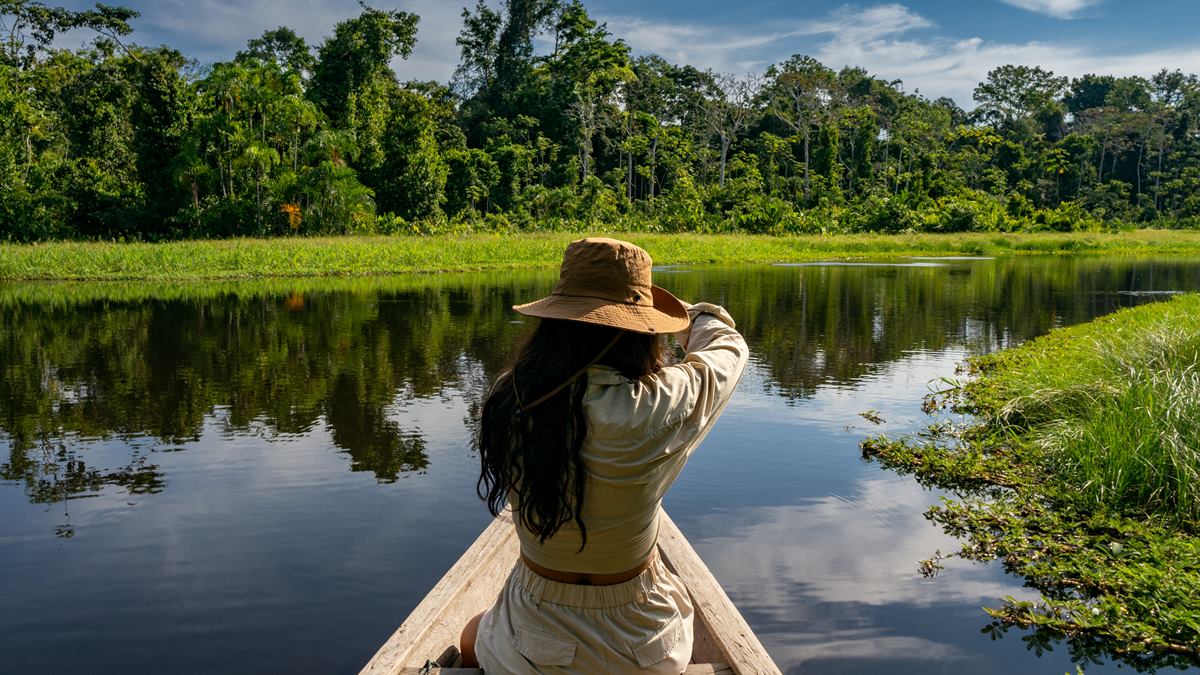
Before travelers reach the Amazon, the pink dolphin already lives in their imagination. It is one of those animals that generates expectations from the moment it appears in the first search for "what to see in the Amazon." But most come with the wrong image — that of the agile, bouncing sea dolphin who does acrobatics at water shows. The boto, the pink Amazon River dolphin, is something else entirely.
Bigger. Slower. More mysterious. And much more fascinating.
Who is the Boto?
The boto (*Inia geoffrensis*) is the largest river dolphin in the world. It does not live in the sea — it exclusively inhabits the rivers and lakes of the Amazon and Orinoco basin, from Venezuela to Bolivia, passing through Colombia, Brazil and Peru.
It can reach between 2 and 2.5 meters in length and weigh up to 185 kilos in adult males. It is a mammal: it breathes air, gives birth to live young and nurses them for months.
Its coloring is what makes it unmistakable. The boots are born gray. Over the years, the skin loses pigmentation and acquires pink tones that intensify in adult males. That pink is not permanent or uniform — it becomes brighter when the animal is active or excited, because blood flow to the skin increases. It's not a trick of the light: it's physiology.
Anatomy of the Boto: Adapted to the Jungle
The boto is not a sea dolphin that moved to the river. It is its own evolutionary lineage, separated from marine dolphins millions of years ago, with specific adaptations for life in the Amazon:
Flexible neck: The boto can turn its head up to 90 degrees to each side. Sea dolphins can't — their cervical vertebrae are fused for speed. The boto has them free to maneuver between roots and submerged branches with surgical precision.
Reduced dorsal fin: Instead of the high, triangular fin that we recognize in sea dolphins, the boto has a low, elongated crest. Designed for narrow spaces between the trees of the flooded jungle.
Bulbous melon: The prominent forehead houses a highly developed echolocation system to orient itself in dark and murky waters where visibility may be zero.
Mixed teeth: Conical at the front for catching fish, molars at the back for crushing small turtles and crayfish. A dietary specialization that no marine dolphin has.
Movement: Slow, deliberate, deliberate. It appears, breathes with a characteristic sound and submerges again. It does not make the spectacular leaps of the sea dolphin. It has a different elegance — calmer, more mysterious.
El Tucuxi: The Gray Dolphin of the Amazon
Where there are botos there are almost always tucuxis (*Sotalia fluviatilis*) — the gray dolphins of the Amazon. They are smaller (1.3–1.5 meters), with more dynamic behavior. They jump, follow the boats, swim in large groups near the surface.
The rule of thumb to tell them apart on the river: if you see dolphins actively jumping next to the boat, they are tucuxis. If you see something larger emerging slowly, barely showing its pink back before submerging again, it's the boto.
On tours from Leticia it is common to see both species on the same route, especially in Lake Tarapoto and in the section of the river between Leticia and Puerto Nariño.
El Boto in Amazonian Mythology
For the indigenous peoples and riverside communities of the Amazon, the boto is not just an animal — it is a being that lives between two worlds.
The best-known legend in the entire basin: as night falls, the boto transforms into a young, handsome man, dressed in impeccable white. He comes out of the river and seduces the women of the riverside communities. At dawn he returns to the river once again transformed into a dolphin. The wide-brimmed hat he always wears hides the breathing hole at the top of his head.
This story has historically served as a protection mechanism: killing a boto was taboo in many communities. Whoever did it expected bad luck, illness, accident. This deep cultural respect contributed for centuries to preserving the animal's populations in areas where other factors would have reduced their numbers.
Where to See the Boto in Leticia Amazonas
Lake Tarapoto (Puerto Nariño): The best viewing point in the region. Quiet lagoon system, away from the main current of the river, where the botos gather regularly. The calm of the lake allows you to follow its movements with clarity that is difficult to achieve in the open river.
Yahuarcaca Lagoon System (Leticia): Minutes from Leticia. In winter (February–May), when the water rises and the jungle floods, the dolphins enter the channels between the trees. Kayak sighting here is a different experience — without a motor, without noise, with the boat emerging meters from the paddles.
Amazon River Leticia–Puerto Nariño section: Along the 87 km river route it is common to find botos and tucuxis, especially at river confluences and low current areas.
Loretoyaco River (Puerto Nariño): Common sighting point, especially in the early hours of the morning.
Sighting by Season
Amazonian summer (June–November): The botos are in the main channels — more concentrated, more predictable. Lake Tarapoto at its lowest level has less area but a greater density of dolphins. Sighting from a boat is more consistent.
Amazonian winter (December–May): The botos disperse through the flooded varzeas following the fish that also take advantage of the high water. The kayak sighting — the boto emerging among the trees of the submerged jungle — is an unrepeatable image. Less predictable than in summer but incomparable when it happens.
The Best Times of the Day
6–9 am (early morning): Increased feeding activity. Tours that depart at 7 am from the civil port of Leticia take advantage of exactly this optimal schedule.
4–6 pm (afternoon): Second busiest window. Useful for full-day tours with return at sunset.
Midday: Less activity — dolphins tend to be quieter during the hottest hours.
How does the Sighting Tour Work
The standard route from Leticia:
- 7:00 am: Departure from the civil port by boat
- ~9:00 am: Arrival in Puerto Nariño
- Morning: Small boat to Lake Tarapoto — sighting of botos and tucuxis
- Lunch: Puerto Nariño (Las Margaritas Restaurant)
- 3:30 pm: Return to Leticia
- ~5:30 pm: Arrival in Leticia
For a more complete experience: 3, 4 and 5 day plans with multiple sighting outings at different points and times, including kayaking in Yahuarcaca in the winter season.
Tips for Seeing It Up Close
Silence when the guide indicates it: When the engine turns off and the boat floats, the boats get closer. Low voices, without sudden movements.
Patience without fixed expectations: It is not an aquarium. Sometimes they appear in seconds, sometimes you have to wait. Waiting at Lake Tarapoto, with that landscape, is not wasted time.
Camera ready upon boarding: The boto emerges, breathes and disappears in seconds. The phone at the bottom of the backpack at that moment is avoidable frustration.
Do not attempt to touch or swim with them: Respectful viewing — observing without interfering — ensures that the animal's natural behavior is not altered and that populations remain healthy.
Conservation: The Future of Boto
The boto is classified as endangered species by the IUCN. Your main threats:
- Mercury pollution from illegal gold mining in the basins
- Accidental fishing in nets
- Destruction of várzea systems
- Direct hunting in some areas of Brazil and Peru
The Colombian Amazon maintains one of the healthiest populations of botos in the entire basin. Low mining pressure in the Leticia area, historical indigenous cultural respect for the animal, and responsible ecotourism have contributed to this region being a relatively safe haven for the species.
Hiring tours with responsible and certified agencies is a direct contribution to conservation — well-managed ecotourism generates economic incentives to protect the river.
Frequently Asked Questions
Why is it called a pink dolphin if not all of them are pink? The botos are born gray and turn pink with maturity. The color intensifies when they are active — blood flow to the skin increases. Adult males are pinker than females.
Can you see the boto all year round in Leticia? Yes. The Colombian Amazon has a permanent population of botos. The type of sighting varies: in summer from a boat in the main channels; in winter kayaking in the flooded jungle.
Is there a guarantee of seeing dolphins on the tour? There is no guarantee with wildlife. However, Lake Tarapoto has very high concentrations of botos and guides with local experience know their movements. The probability of sighting on a well-organized tour is very high.
Are the boto and the tucuxi the same species? No. The pink boto (*Inia geoffrensis*) and the gray tucuxi (*Sotalia fluviatilis*) are different species. The boto is bigger and slower; the smallest and most active tucuxi. Both inhabit the Colombian Amazon.
Is the pink dolphin in danger of extinction? Yes. Classified as an endangered species by the IUCN. The Colombian Amazon has one of the healthiest populations due to low mining pressure and historical indigenous respect.
*See the boto in its habitat: leticia.travel*
Do you want to experience the Amazon with a clear route?
Write to us on WhatsApp and we will help you choose between a 2, 3 or 4-day tour depending on your flight, season and travel style.